
What is Khmer food?
Khmer food is the home cooking of Cambodia: fresh, fragrant and built on balance. A good Khmer dish plays salty, sour, sweet and bitter against each other rather than relying on chilli heat, which is why it is usually gentler than its Thai neighbour. Rice is at the centre of every meal, and the rivers and the Tonlé Sap lake supply the freshwater fish that appear in soups, curries and pastes.
Five ingredients come up again and again in Khmer cooking:
- Kroeung — the aromatic base paste, pounded from lemongrass, galangal, turmeric, garlic, shallots and kaffir lime.
- Prahok — fermented fish paste, the deep, savoury note in many Cambodian dishes.
- Fresh herbs — mint, basil, coriander and others, served generously with almost everything.
- Palm sugar, lime and tamarind — the sweet and sour that keep dishes in balance.
- Kampot pepper — Cambodia's famous pepper, often paired with lime as a dipping sauce.
Classic Khmer dishes to try in Phnom Penh
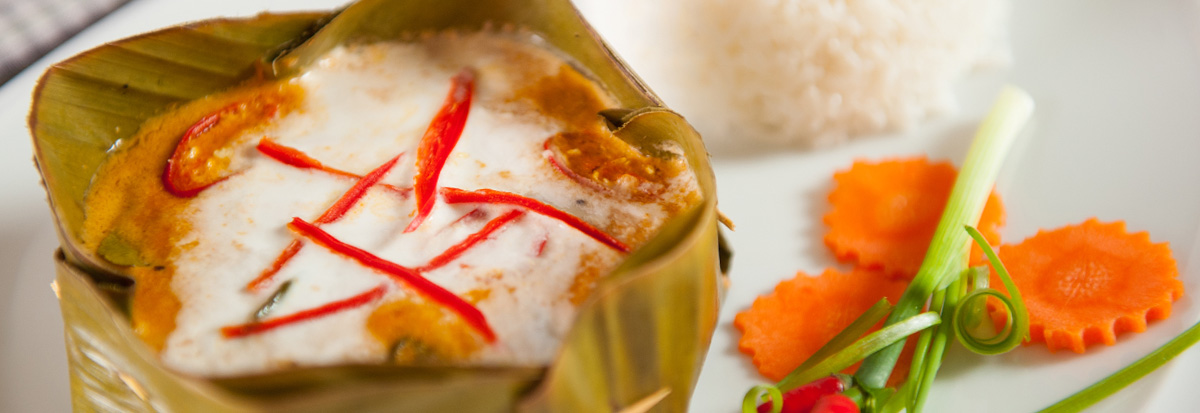
Fish amok (amok trey)
Fish steamed with coconut milk and kroeung until it sets into a soft, mousse-like curry, traditionally served in a banana leaf. Fragrant, creamy and mild — the dish most visitors are told to try first.
Lok lak
Cubes of marinated beef stir-fried quickly and served with salad, tomato, rice and a dipping sauce of lime juice and black pepper. Simple, savoury and an easy introduction to Khmer flavours.
Kuy teav
A clear pork-bone noodle soup, topped with herbs, fried garlic and lime. It is a Cambodian breakfast staple, eaten at markets and street stalls across the city.
Nom banh chok (Khmer noodles)
Fresh rice noodles topped with a fish-based green curry and a pile of raw vegetables and herbs. Often eaten in the morning, it shows off kroeung at its freshest.
Bai sach chrouk
Grilled marinated pork over rice with pickled vegetables — another classic Cambodian breakfast.
Samlor (Khmer soups)
Cambodia has a family of soups known as samlor, from sour, herb-heavy broths to richer, thicker versions. They are eaten alongside rice as part of a shared meal.
Where Khmer food starts: the market
The best way to understand Khmer food is to see the ingredients before they are cooked. Phnom Penh's markets are full of fresh herbs, river fish, pastes and spices, and a guided walk through one explains a lot about why Cambodian dishes taste the way they do. That is why our morning and full-day classes begin with a market visit.
Learn to cook Khmer food in Phnom Penh
Eating Khmer food is a good start; cooking it is better. At La Table Khmère, our cooking school near Wat Phnom, you work at your own equipped station and cook a complete Khmer meal — a starter, a main course and a dessert — then sit down and eat it. Every recipe is emailed to you, so you can recreate the dishes at home. Beginners are welcome.
Book a cooking class How the classes work
Classes start at US$31 per person — see all cooking class prices in Phnom Penh.
Khmer food FAQ
What is Khmer food?
Khmer food is the traditional cuisine of Cambodia. It balances salty, sour, sweet and bitter flavours and relies on fresh herbs, lemongrass, galangal, turmeric, kaffir lime, rice and freshwater fish.
What is the national dish of Cambodia?
Fish amok — fish steamed with coconut milk and a fragrant Khmer curry paste, traditionally in a banana leaf — is widely regarded as Cambodia's signature dish.
Is Khmer food spicy?
Generally milder than Thai food. Chilli is usually served on the side so each person can adjust the heat to taste.
Is Khmer food the same as Thai or Vietnamese food?
No. Cambodian cuisine shares ingredients and influences with its neighbours but has its own character: aromatic pastes such as kroeung, fermented fish (prahok) and a focus on balance rather than heat.
Can vegetarians eat Khmer food?
Many traditional dishes use fish sauce or fish paste, so it helps to ask. In our Phnom Penh cooking class we adapt the menu for vegetarians and allergies — note your needs on the reservation form.
Where can I learn to cook Khmer food in Phnom Penh?
At La Table Khmère, a hands-on cooking school near Wat Phnom in Phnom Penh. You cook a starter, a main course and a dessert at your own station, from US$31 per person.